
From the womb to the classroom
Doc Lobe's research follows one question across a lifetime: how does stress, and especially the generational trauma carried by Black families, reach a child before birth, and how can education either repeat that harm or interrupt it? These materials show the two halves of that work.
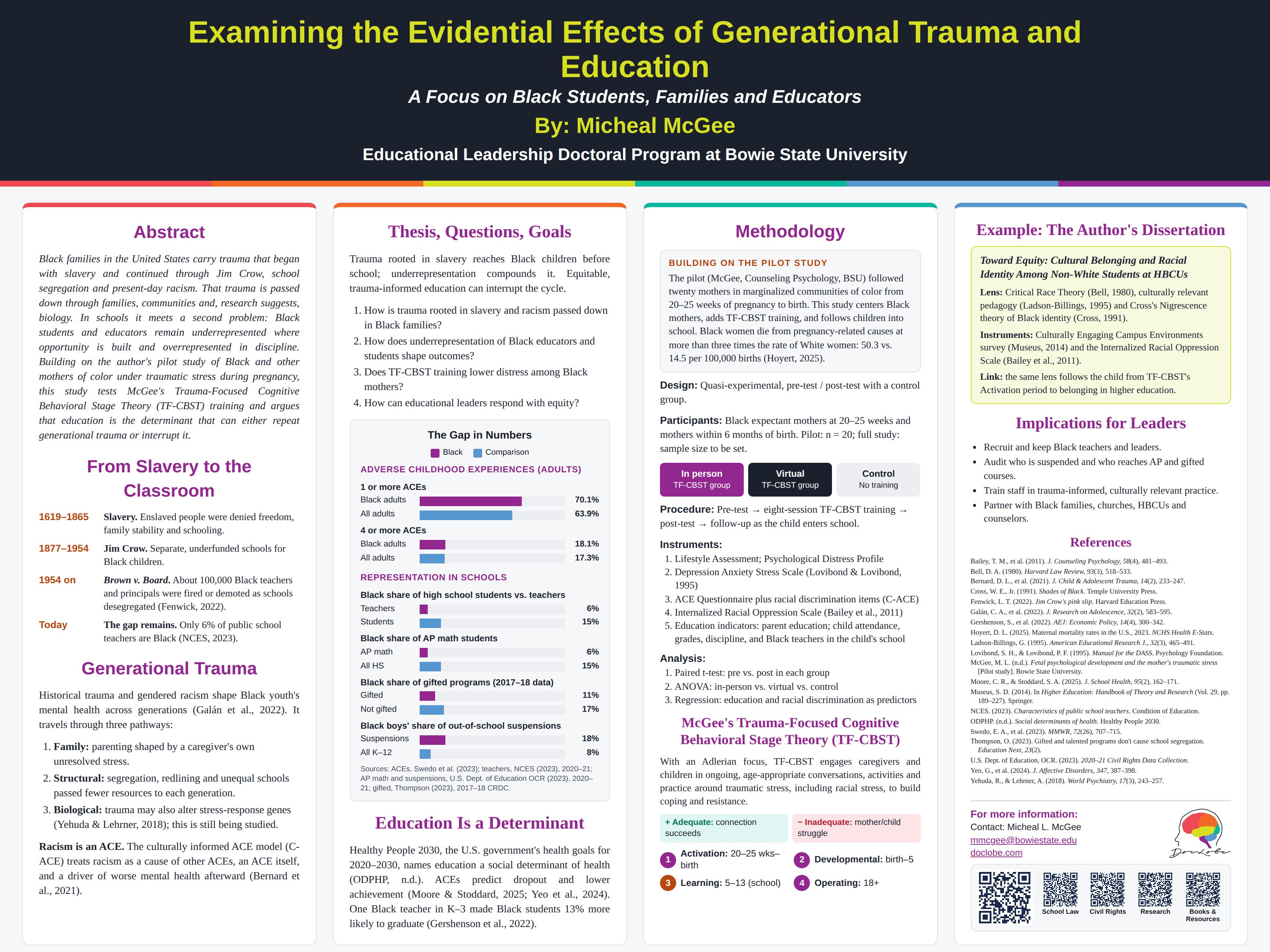
Examining the Evidential Effects of Generational Trauma and Education
A Focus on Black Students, Families and Educators. Micheal McGee, Educational Leadership Doctoral Program, Bowie State University.
What the poster argues
Trauma that began with slavery did not end with it. It continued through Jim Crow, school segregation and present-day racism, and it is passed down in three ways: through families (parenting shaped by a caregiver's own unresolved stress), through structures (segregation, redlining and unequal schools that left each generation with fewer resources), and possibly through biology, an area still being studied. The poster's thesis is that this trauma reaches Black children before they ever enter school, that underrepresentation in schools compounds it, and that equitable, trauma-informed education can break the cycle.
How to read it
The poster moves left to right. The first column sets the history, from slavery to the loss of about 100,000 Black teachers and principals after Brown v. Board. The second states the research questions and shows the gap in numbers. The third lays out the study design and McGee's Trauma-Focused Cognitive Behavioral Stage Theory (TF-CBST). The fourth links the work to the author's dissertation on belonging at HBCUs and closes with what school leaders can do.
The study and the TF-CBST model
The proposed study is quasi-experimental, with a pre-test, a post-test and a control group. Black expectant mothers (20 to 25 weeks pregnant) and mothers within six months of birth are placed in an in-person TF-CBST group, a virtual TF-CBST group, or a control group with no training. After eight sessions, mothers are tested again and followed as their children enter school. Measures include the Depression Anxiety Stress Scale, the ACE questionnaire with racial-discrimination items, and the Internalized Racial Oppression Scale, alongside school indicators such as attendance, grades, discipline and whether the child has Black teachers.
TF-CBST takes an Adlerian approach: caregivers and children keep having age-appropriate conversations and practice around traumatic and racial stress to build coping and resistance. It names four stages, each of which can go well (connection succeeds) or poorly (mother and child struggle):
The implications for leaders are practical: recruit and keep Black teachers and leaders, audit who is suspended and who reaches AP and gifted courses, train staff in trauma-informed and culturally relevant practice, and partner with Black families, churches, HBCUs and counselors.
Fetal psychological development and the mother's traumatic stress
The pilot study that the generational trauma poster builds on.
The fetal development work, completed in Bowie State University's Counseling Psychology program, followed twenty mothers in marginalized communities of color from 20 to 25 weeks of pregnancy until birth. It asked how a mother's traumatic stress during pregnancy relates to the psychological development of the child she is carrying.
The idea rests on a well-established line of research called the developmental origins of health and disease. When a pregnant woman is under heavy or long-lasting stress, her stress-hormone system (the HPA axis) stays switched on. Some of that signal crosses the placenta, and the developing baby's own stress system, brain and behavior can be shaped by it. Reviews of this research link high stress during pregnancy with later differences in children's emotional and behavioral regulation, though most children of stressed mothers develop typically and support after birth matters a great deal (Van den Bergh et al., 2020).
For Black mothers, this risk sits on top of a maternal health crisis: Black women die from pregnancy-related causes at more than three times the rate of White women (Hoyert, 2025). That is why the full study centers Black mothers, adds TF-CBST training during pregnancy (the Activation stage), and keeps following the children into school.
The pilot's poster and the updated Fetal Development slides will appear here once they are added to the site.
One line across a lifetime
Read together, the two projects follow the same child from before birth to adulthood, with education as the turning point.
Before birth
The fetal development pilot shows where the cycle can start: a mother's traumatic stress, including racial stress, during pregnancy.
Early childhood
Parenting shaped by unresolved stress and fewer family resources are two of the three ways trauma is handed down.
School
The generational trauma poster shows the gaps children meet in school: few Black teachers, unequal access to AP and gifted courses, and more suspensions.
Higher education and beyond
The author's dissertation on cultural belonging and racial identity at HBCUs carries the same lens into college and adulthood.
Explore the background on this site: the DNA and the Epigenome lesson covers prenatal stress and intergenerational trauma, Body and Brain walks through the HPA stress axis, and Equity in Education covers school law and the civil rights history the poster draws on.
References
- Fenwick, L. T. (2022). Jim Crow's pink slip: The untold story of Black principal and teacher leadership. Harvard Education Press.
- Gershenson, S., Hart, C. M. D., Hyman, J., Lindsay, C. A., & Papageorge, N. W. (2022). The long-run impacts of same-race teachers. American Economic Journal: Economic Policy, 14(4), 300–342.
- Hoyert, D. L. (2025). Maternal mortality rates in the United States, 2023. NCHS Health E-Stats. cdc.gov/nchs/maternal-mortality
- National Center for Education Statistics. (2023). Characteristics of public school teachers. Condition of Education. nces.ed.gov/programs/coe/indicator/clr
- U.S. Department of Education, Office for Civil Rights. (2023). 2020–21 Civil Rights Data Collection. civilrightsdata.ed.gov
- Van den Bergh, B. R. H., van den Heuvel, M. I., Lahti, M., Braeken, M., de Rooij, S. R., Entringer, S., Hoyer, D., Roseboom, T., Räikkönen, K., King, S., & Schwab, M. (2020). Prenatal developmental origins of behavior and mental health: The influence of maternal stress in pregnancy. Neuroscience & Biobehavioral Reviews, 117, 26–64. doi.org/10.1016/j.neubiorev.2017.07.003
- The full reference list for the poster appears on the poster itself (download the PDF above).